
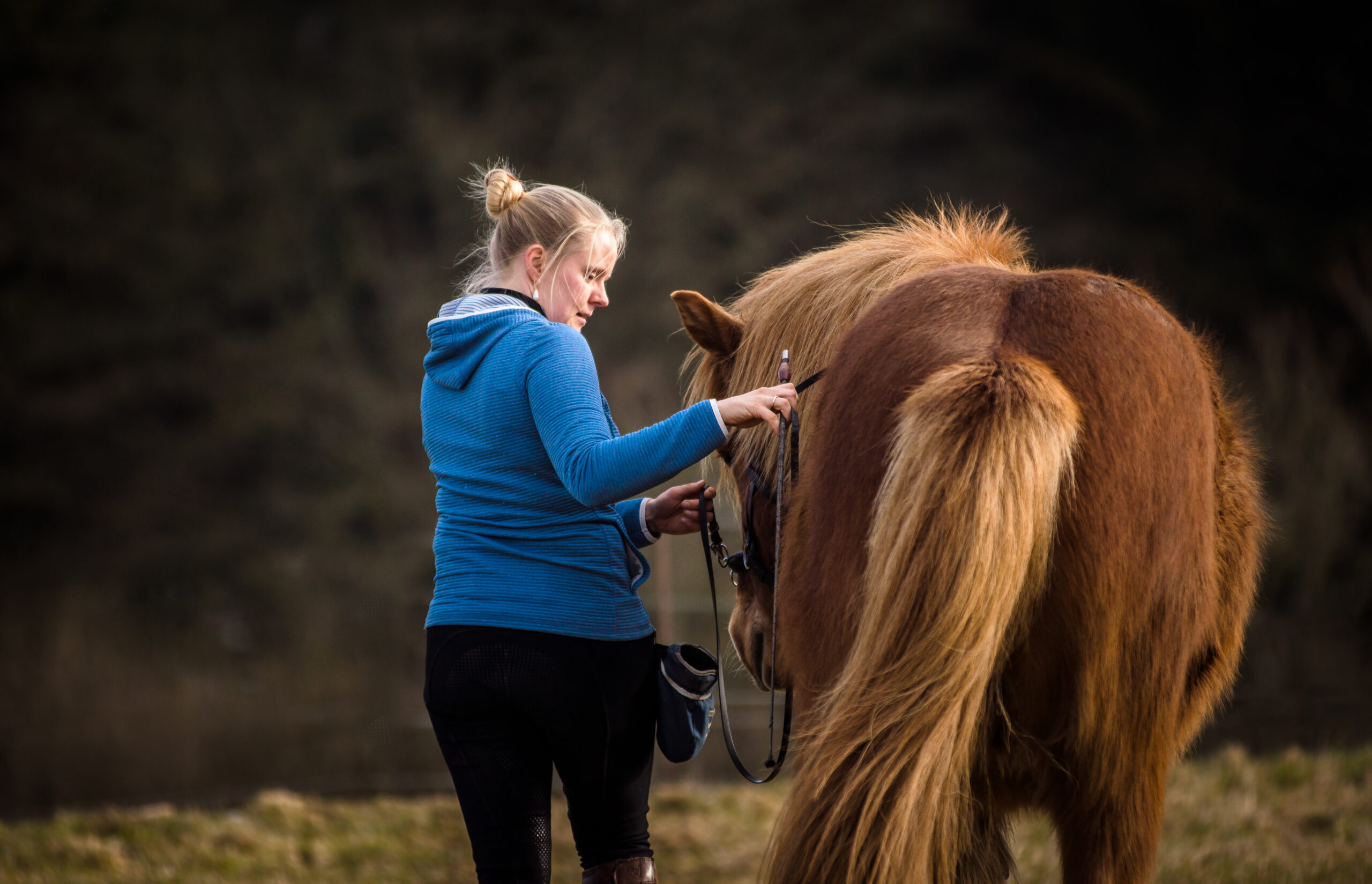
In equitation science, every leg aid, every rein contact, every physical touch between rider and horse is currently classified as aversive — something the horse is motivated to escape or avoid. That is the underlying assumption of negative reinforcement as it’s applied to horses, and it shapes how researchers and trainers think about everything from basic handling and riding to welfare assessments. A 2025 narrative review by Bradshaw-Wiley et al. puts it plainly: negative reinforcement “facilitates communication from the human to the horse through physical interactions,” with tactile pressure applied to motivate behavioural change “in an attempt to relieve the discomfort caused by its application.”
As a human and veterinary physiotherapist who works with pressure and tactile stimuli every day, I believe this assumption deserves serious scrutiny. That same review has brought the question into sharp focus for me, and I want to use it as a starting point to explore:
Is all tactile contact genuinely aversive to a horse?
I have worked professionally with horse training since 2013 – where I was taught about euine learning theory. And let me just say: Learning about the 4 quadrants of operant conditioning was like seeing a light from heaven.
Suddenly everything made sense and I could train horses with much less confusion, stress and pressure to both of us. My training became much more structured and when applying the “simple” rules of negative reinforment I could train my horses to literally anything in a short while and only occasionally did I have to increase the pressure.
Naturally, since my horses aren’t stupid. After a very short indoctrination period, they quickly realised that they had to follow the pressure to release it if they wanted to avoid it increasing to more aversive levels.
But not long after I started questioning why horses is the only species taught primarily though aversive pressure?
So I started incorporating a lot of positive reinforcement or combined reinforcement to motivate my horses, being more mindfull of their emotional responses and emotional states, learning about calming signals to be able to discover upcoming problems earlier and so on.
But then I started questioning whether the human-horse bond has to be contingent on aversive stimulus? Wouldn’t the horses find it more fun to be around us if everything wasn’t built on something aversive?
So for a while I tried to avoid all negative reinforment. And since my understanding of negative reinforcement was the same as the one expressed by the authors I tried to avoid any physical contact outside of grooming. This arguably makes horse training and riding more difficult and requires you to think outside the box. But sitting on a horse I can’t see how you can avoid all physical contact and interaction.
My experience from my physiotherapy practice and my always inquisitive mind kicked in and questioned why all tactile interaction, except rubbing in a nice spot, was considered aversive in the first place?
Obviously as a manual therapist my hands can find a sore spot and prod this hard enough to elicit pain. But very often my hands and my touch is perceived as, if not always comfortable, then at least neutral.
Touch isn’t discrete nor are the 4 quadrants, but should rather be looked at on a continuous spectrum.
I do not believe that all horses find it aversive with a light pressure to the halter. Or that the shifting of my weight in the saddle is aversive. Like I don’t believe that two dance partners moving in tandem are subjecting each other to aversive tactile stimuli to make this happen. And I actually think that most (also the researchers in the paper!) would agree with me so far.
Touch is communication – a tactile cue that lets the horse know what I wish at a given time. But I am not obliged to use touch (or the removal hereof) as a negative reinforcer to make horses do as I want. And here is where i think scientists need to make a distinction:
Giving a tactile cue is not the same as applying negative reinforcement.
A tactile cue is merely a cue; a signal to the horse. The cue can be given for the whole duration of the wished execution of the behaviour associated with the cue; like we humans are expected to wait for the whole duration of a red traffic light. Or it can be a single short cue given as a “green light” to perform the associated behaviour.
If you do not increase the tactile pressure to anything perceived as aversive by the horse then it can’t be negative reinforcement. One could even argue, if the tactile pressure is salient to the horse, that the removal will be negative punishment instead.
The authors of the review anticipate this line of thinking and push back on it. They argue that even in training systems that claim to avoid aversive pressure, the underlying mechanics of negative reinforcement are still at work:
“Instances in which positive reinforcement conditioned responses are chained to pressure-based cues, such as leg to indicate the ‘go’ response under saddle, it is believed that the stimulus is not perceived to be aversive by the horse due to prior conditioning. While the stimulus may not be considered to have aversive characteristics in the sense of it being highly unpleasant or fear inducing, the use of pressure and its release becomes built into the reinforcement contingency.”
This is a serious argument and worth sitting with. But I think it reveals a circularity: The reasoning assumes that any tactile cue which produces a response and is subsequently removed must be aversive — because if it weren’t, removing it wouldn’t function as reinforcement. This overlooks the possibility that a cue can be salient without being unpleasant. A tap on the shoulder gets your attention without causing discomfort. You don’t turn around to escape the touch — you turn around because the tap signalled that someone wants your attention. The cue is communicative, not aversive.
But whether a tactile cue remains truly non-aversive depends entirely on who is receiving it. The same signal can be neutral to one horse and deeply unpleasant to another — and even the same horse on a different day. Every horse is an individual with their own personality and history, and we need to take their daily state into account too, as arousal and physical discomfort can all affect perception of a stimulus.
A migraine patient might react very strongly to “normal” light or sound during a migraine attack. The same is likely true for horses. A mare in heat might be more sensitive due to pain from her reproductive system making normal light touch painful and thus aversive on that day. A previously abused horse might find a quick visual movement aversive.
Therefore it is the horse who defines what is aversive. And if it is not aversive it is not negative reinforcement.
If it is truly just a tactile cue there shouldn’t be any repercussions from not performing the behaviour. There shouldn’t be an increase of pressure or a constant nagging. If the horse doesn’t respond to the cue you need to find a non-aversive way of motivating the horse to perform the behaviour.
Don’t misunderstand me here. I am not against all negative reinforcement and realistically we can’t avoid it completely. But I can’t justify consciously subjecting my horse to a default aversive training system to satisfy my own training goals.
Therefore we need to rethink how we train horses: a tactile cue is not the same as an aversive stimulus. We need to become better at minimizing aversive aspects of training – whether from physical discomfort or psychological stress. I fully believe that riding is possible without a systematically aversive foundation – we just need to train those tactile cues differently.